Want to get started?
See how memberships, Direct Debit, Annual Passes and Gift Aid work in Ticketsolve. We'd love to show you around.

Our guide to setting up a model that works for your organisation, covering Gift Aid, Memberships, Donations and Annual Passes.


For many venues, ticket-based income is far from regular. Seasonal dips, large peaks that reflect large onsales…Irregular income is a regular occurrence.
Many venues turn to recurring income to even things out and guarantee income no matter the season. From members who give yearly to donors who provide regular income, or annual passes that guarantee a cohort of returning visitors - there are various options, depending on your venue type. And many models can be boosted by Gift Aid, if you’re a charitable organisation.
It’s a setup more and more venues are turning to, as well. In Indigo's Membership Matters report, 86% of the 57 cultural organisations surveyed said that the main reason they run a membership scheme is to bring in additional income.
Setting up a recurring revenue model that works for your organisation can bring up various questions: what will you offer? How will people pay? Where does Gift Aid fit, and which rules apply to you? We've set out the need-to-knows below, with links to our more detailed guides for deeper dive.
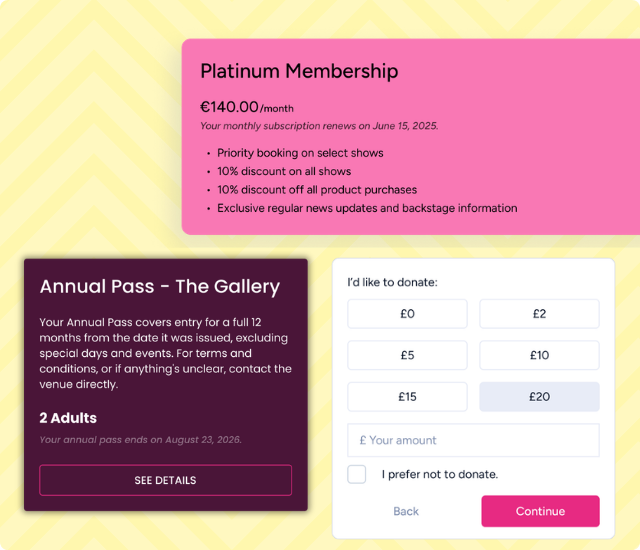
Terms surrounding recurring income can be used interchangeably. When we refer to “recurring income” we mean money that is received regularly, from the same person, without them having to decide to purchase again each time. With regards to related terms, we define them as follows:
In practice, some of these may overlap. Plenty of friends schemes prioritise giving and a connection to your organisation rather than providing benefits, and an annual pass can be defined as a donation (and qualify for Gift Aid) if it's set up the right way.
Beyond the terms you use, it’s important to decide what you’re aiming to achieve through your regular giving scheme - as that will determine the rules you need to follow.
Memberships and friends schemes come in all shapes and sizes. Some are based around a single fixed-price tier, while others offer several levels. They also vary in terms of what they’re offering to customers, as per the following:
A “commercial” type membership is probably most familiar to consumers: members pay a fee and receive a comparable return in the form of priority booking, ticket discounts or money off in the café and bar. It's a great way of thanking your most frequent visitors and supporters, and is also a way of encouraging them to visit more often.
A philanthropic membership is more about giving than receiving: the amount paid is greater than the value of the benefits, if there are any benefits at all, and people join simply because they want to support your work. In this case, benefits often reflect members’ proximity to your work, such as access to behind-the-scenes events, the opportunity to meet artists, and having their name listed in the programme.
Most membership schemes are somewhere in the middle. When setting up your membership, it’s worth considering which benefits you’d like to offer, as this will often determine how many membership tiers or types you can offer.
. Indigo’s Membership Matters report revealed that although 70% of audiences stated that free or discounted tickets were the type of benefit that they valued most, organisations tended to place such offers at the bottom of their own priority list. Moreover, the same study showed that 57% of potential members refrain from joining because they are concerned that they won't attend frequently enough for it to be worthwhile. Indigo refers to this as 'loyalty anxiety'.
As a rule, it’s best to make the benefits simple and easy to understand and to make the commitment as small as possible. It helps if people are able to pay on a monthly basis, as does offering benefits that function outside the auditorium, for example the discount for the café and bar included by Galeri Caernarfon in its scheme.
Begin by calculating the cost of the benefits if all members took advantage of them, then determine how much additional revenue you would like to earn as income or as a donation. Next, check what similar or nearby venues charge. If you are thinking of offering different tiers, make sure the differences between them are clearly identifiable for a new potential member.
For organisations who are showcasing a building or collection, an annual pass can be a good alternative to a membership. They are simple to sell both on the day of the visit and in advance, and provide a good incentive for return visits. If set up properly, annual passes may also be eligible for Gift Aid. Our guide annual passes, memberships and Gift Aid explains the two structures that work according to HMRC’s rules, and the key guidelines.
If you are launching a scheme from scratch or deciding to revise an existing one, our article on setting up successful membership schemes looks at benefits, tiers and how to launch in more detail.
When a membership renews automatically, it continues to run until someone chooses to stop it, or until the end of the contract. If renewal is dependent on a customer both receiving a reminder email and making a new purchase, memberships can easily lapse. With that in mind the most important choice you can make to protect your recurring membership is your payment method.
In the UK and Ireland there are two primary choices: Direct Debit and recurring card payments (officially known as a Continuous Payment Authority or CPA).
When using Direct Debit, the customer gives you the right to withdraw money from their bank account. In the UK this is carried out via the Bacs system and is backed by the Direct Debit Guarantee, which ensures that if a payment is taken by mistake, the person who was charged will receive a prompt refund from their bank. In Ireland, payments are covered by SEPA Direct Debit Core scheme, which allows authorised payments to be challenged within eight weeks - this extends to 13 weeks for unauthorised payments.
Direct Debit is an ideal payment solution for both annual and monthly memberships, guaranteeing continuity for both you and your members - as bank accounts never expire and are rarely changed, collection payments can continue year after year without the member having to update their details.
A Continuous Payment Authority allows a customer to make recurring payments by card. In this case, supporters grant you the right to charge their debit or credit card on a regular basis, and, unlike in the case of direct debits, the agreement you make is with the supporter, not with their bank. A CPA is simple to set up online, including via Apple or Google Pay, and it is suitable for supporters who do not have a bank account in the UK or Ireland.
The problem often flagged with CPAs is that that card can expire, or can be lost and then replaced. A membership could therefore lapse without anyone realising it, unless your system attempts the payment again and asks the member to update their details, or unless a member’s bank offers automatic card updates.
Our Guide explains how to set up recurring card payments so supporters know what they’re agreeing to and feel confident when signing up.
By offering a choice between Direct Debit and recurring card payments, your supporters can pay according to their own preferences, removing any potential friction at the point of signing up. We look at the advantages and disadvantages of both, for your team and for your audiences, in our article on Direct Debit or recurring card payments.
No matter which method you choose, some payments are going to fail - so it’s important you have a back up system in place. With Ticketsolve, failed card payments are automatically reattempted using our smart card retry feature, and our automated membership expiry campaign reminds members to check their payment details. Together, these measures help recover income that would otherwise be lost.
If you want to know more about how Direct Debit and CPA work, including key rules and regulations to have in mind, see our guide to Direct Debit, CPA and subscriptions.
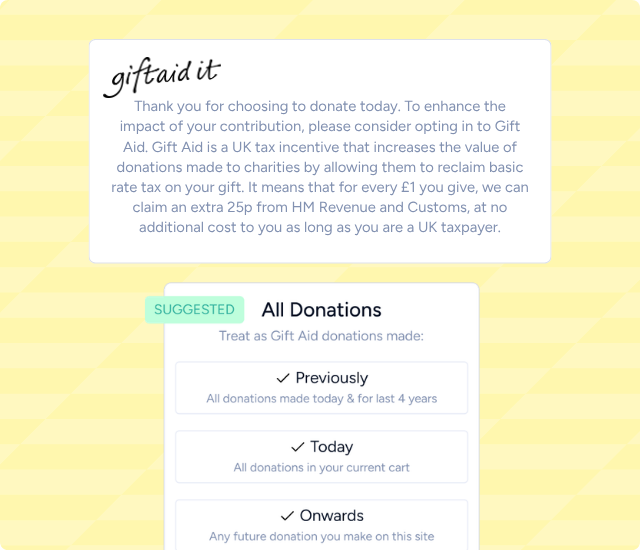
Through Gift Aid, UK charities can claim an extra 25 pence from HMRC for every £1 donated by a UK taxpayer. This additional amount can add up quickly, especially for a venue claiming Gift Aid from memberships, donations and ticket purchases. For those claiming Gift Aid for the first time, or seeking to claim it on a new scheme, it’s worth familiarising yourself with the rules that apply to different product types:
As a rule, Gift Aid does not apply to ticket purchases - as it is not a gift, and the buyer receives something in return. However, HMRC stipulates two exceptions, both applicable to charities who showcase their work and collections to visitors. In the first instance, venues can accept a donation which grants free or reduced admission. In the second one, visitors can choose to add a voluntary donation of at least 10% to the standard admission price, allowing the full amount to qualify for gift aid. As performances generally do not qualify, these rules apply more to museums, galleries, heritage sites and attractions than to theatres.
Our resource breaks down these rules further.
You may be asked this question by your visitors. Gift Aid-able tickets are more expensive as HMRC requires them to be priced at least 10% above the standard price if the whole amount is to be regarded as a donation. By paying a bit more, the visitor enables the venue to claim an additional 25% on the total amount. Non-UK tax payers or those who do not want to donate can pay the standard price and receive the same benefits. It’s worth presenting the additional amount as a “donation” to make it easier for those who may be unfamiliar with the offer to understand.
Membership fees can qualify for Gift Aid under two circumstances. First, if the membership provides a right of admission, it will be covered under the ticket purchase rules outlined above. Under the same rules, annual passes, which provide access to a venue for a period of at least 12 months, are also eligible for Gift aid. Secondly, if membership or pass provides additional benefits, the value of these must stay within the limits specified by HMRC. For memberships or passes that cost up to £100, benefits can’t exceed 25% of the value of the benefit. For those that cost between £101 and £1,000, the value limit shifts to £25 plus 5% of the value over £100, and for those that cost over £1000, the total value of any benefits is capped at £70.
Thus, if you’d like to provide additional benefits to say thank you to your members or passholders, ensure that these aren’t too generous or your entire scheme may become ineligible for Gift Aid.
Our guide on annual passes, memberships and Gift Aid explains the rules in detail, alongside common mistakes and how Ticketsolve handles the mechanics.
In order to claim Gift Aid, you must collect a declaration from your donors, including their full name and their home address together with confirmation that they are a UK taxpayer, paying at least as much Income or Capital Gains Tax as the amount claimed by your venue. The declaration can be made online, in writing or verbally, provided that you keep a record of it. The simplest way to collect your declaration is during the booking or sign-up process - this appears automatically when collecting a donation online or at the box office in Ticketsolve.
The Gift Aid Small Donations Scheme (GASDS) enables eligible charities to claim a 25% top-up (similar to that offered under Gift Aid) on cash and contactless donations of £30 or less, without having to make a declaration. Charities can submit a claim on up to £8,000 of small donations each year, which amounts to a top-up of up to £2,000. The scheme is applicable to donations collected via donation boxes, plus donations made at the till and at contactless donation points.
Ireland has no Gift Aid scheme; instead it has the Charitable Donation Scheme under which approved charities are entitled to claim tax relief when a donor gives €250 or more in a single year.
Chances are, most of your most devoted and regular visitors already support your organisation via donations. By setting up regular donations, they are simply continuing that support according to a set schedule, typically on a monthly basis, with the added benefit of an additional sense of belonging and the knowledge they’re supporting your organisation.
If a supporter gives £5 a month, this works out as £60 a year (or £75 if Gift Aid is applied). As an organisation, it’s also much easier to plan around set, expected donation amounts than a variety of one-off gifts. In the case of recurring donations, where there are no benefits and no “purchase” per se, the whole amount can generally be Gift Aid, provided that you have a declaration.
The most effective time to make “the ask” and suggest that a supporter set up a recurring donation is right after they have demonstrated their care and interest in your organisation. This could be right after they've donated at the point of checkout, following an eventthat they’ve attended, or as part of a follow up or thank you for a previous donation.
With Ticketsolve you are able to set up and manage recurring donations together with tickets and memberships, so all the actions carried out by a supporter are stored in a single record and you can easily segment and target potential donors.
When you are taking recurring payments, you need to take into account two sets of rules. The first are rules relating to the payment scheme, and detailed above, which apply to the collection of Direct Debits or card payments, as applicable. Consumer law, which we’ll go into in this section, sets out exactly what you need to tell your purchasers and how easy you need to make it for them to cancel or withdraw from the agreement.
In Spring 2027 the Digital Markets, Competition and Consumers Act 2024 is due to be updated to introduce new rules concerning subscription contracts. If these rules apply to your organisation, you will need to ensure that:
▸ You provide clear information about what the purchaser is signing up to, when and how much they will need to pay
▸ You send reminders before a free or discounted trial ends, and before contracts of 12 months or longer renew automatically
▸ Cancelling is straightforward, making sure that there is an online option if the person joined online
▸ That you honour two 14-day cooling-off periods, one at sign-up and one after an automatic renewal
According to current comms, charities who are eligible to claim gift aid on donations, memberships and and tickets will be excluded from these rules, as HMRC does not permit gift aid to be claimed on purchases that could be refunded. If you’re not sure if the rules apply to your venue, we’d recommend checking with HRMC or your financial or legal team.
In Ireland, memberships sold remotely (i.e. online) are covered by the Consumer Rights Act 2022. This stipulates that it is necessary to make the price, length of membership and the terms regarding renewal and the right to cancel clear at the time of purchase. The wording at checkout must be clear and free from ambiguity, and you can’t have pre-ticked boxes for sign up or purchase of additional services. Online customers usually have a period of 14 days during which they can change their mind, although exceptions apply to fixed-date leisure services, for example if a purchase provides tickets for a particular concert.
For more details on Direct Debit, CPA and subscriptions, discover our our guide, which also includes a checklist of the things you should have in place.
Many members never cancel their membership, it just lapses - whether they missed the renewal email, the card they had on file expired, or your team just don’t have time to follow up on every lapsed membership. This doesn’t really matter if it happens once or twice, but a few dozen lapsed memberships can eat into your additional revenue - and result in your membership scheme failing to achieve the purpose for which it was established.
Memberships set up with recurring payment types like Direct Debit and CPA make it easier to avoid the recurrence of lapsed memberships, as renewals take place without requiring intervention by the customer or your team. With Ticketsolve, issues with cancelled or lost cards are mitigated by our smart card retries setup, as well as the ability for customers to manage card details via their online account.
In the instances where members do decide to cancel, this is often because they feel they’re not making the most of their membership - remember the "loyalty anxiety” from Indigo's Membership Matters report discussed earlier in this article? This is why it’s worth sending regular and specific reminders about what they’re getting, for example when a members-only priority booking window opens, when a new menu lands at the cafe where they can use their discount, or to remind them everything your organisation’s been able to achieve thanks to members.
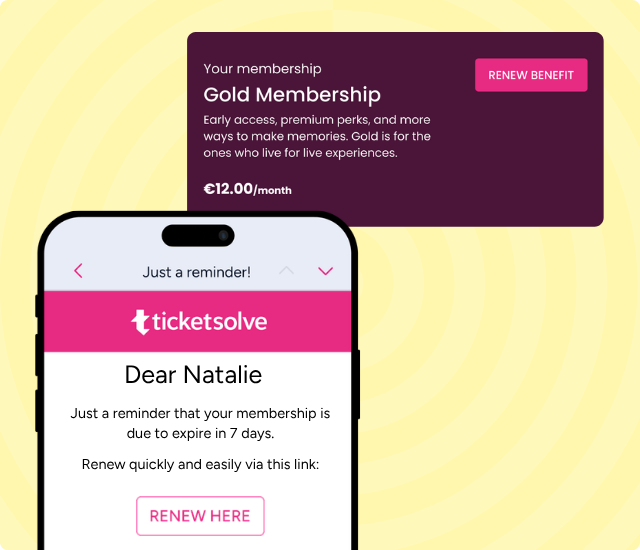
If you don’t have automated renewals set up, or if you’d like to ensure members know exactly what the score is with renewal, our automated membership expiry campaign might come in handy to contact members before their renewal date, while they are still engaged, rather than waiting until their membership has lapsed and they become disengaged.
If you provide more than one method of payment, it’s worth checking out which proportion of members renew using each method. If there’s a particularly high level of lapsed members in one instance, it might be worth switching to one method only, or putting in place additional safeguards.
Galeri Caernarfon is a community enterprise and development trust based in north Wales. It runs a varied programme through its theatre-cinema, alongside event spaces, creative workspaces as well as a busy café and bar. For years, the trust offered a traditional membership scheme named Prima. While Prima provided valued ticket discounts for venue regulars, the team were only able to sign members up via the box office, which limited its reach and potential.
Galeri wanted to expand its membership offering to provide discounts in the café, bar and refreshment kiosk. However, their existing EPOS setup did not have the ability to identify members so they could avail of their discount, and workarounds would have taken a considerable amount of manual effort.
A solution presented itself when Ticketsolve announced its integration with Point One’s EPOS system. Galeri was already considering an EPOS upgrade at this stage - so the team went ahead and developed their new “Prima+” axgwn with that in mind. Each member is now given a printed card bearing a barcode which allows their members’ discount to apply automatically when it is scanned at the till.
'Once we realised that there was integration that could really work for us, that made all the difference.' Eiri Pennington, Operations Manager, Galeri Caernarfon.
Prima+ was launched in the summer of 2026, at a price of £30 per year. Since most members pay through an annual recurring Direct Debit via TS Pay, Galeri receives a steady income and there is no for renewals to be managed manually by Box Office staff. Alongside a 10% discount on food and non-alcoholic drinks, members also receive a discount on full-price cinema and live event tickets. For those purchasing online, discounts are applied automatically after members sign into their online account.
The scheme has been made available to employees and tenants as well as customers, and it now comprises over 250 members. The feedback from visitors and venue regulars has been overwhelmingly positive, and the transition has been painless for the venue team too, with Ticketsolve Pay making administrative work significantly easier for them to manage.
Read the full case study here.
Even the most perfectly-designed membership scheme managed by the most on-the-ball team will result in issues if memberships, donations and CRM are managed in disparate systems. This often results in workarounds, in teams being required to manually bridge the gap, and in a larger margin for error.
When deciding how to set up your membership and donations, and handle recurring payments, you should consider the following:
▸ Are supporters able to choose between Direct Debit or recurring card payments, and can both options be offered online and in person?
▸ Does the system re-attempt failed card payments and remind members to update their details
▸ Does the system capture Gift Aid declarations as part of the membership sign-up or donation purchase process?
▸ Do memberships to renew automatically?
▸ Does the system allow you to set up and manage annual passes?
▸ Can we set up benefits for ticket, product, and F&B purchases without relying on manual workarounds?
▸ Are a customer’s membership details, donation records and ticketing history all stored in the same supporter record?
All of the above is covered by Ticketsolve. Ticketsolve Pay makes it easy to manage Direct Debit and recurring card payments, with the additional benefit of recurrent pcard retries, Our fundraising features handle rolling memberships, recurring donations and gift aids, and our CRM setup ensures a supporters history is stored in one location. Through Event Hub and integrations with EPOS providers like Point One, benefits can be offered at your cafe, bar and beyond.
▸ Direct Debit, CPA and subscriptions: a guide to key rules and regulations
▸ Direct Debit or recurring card? The pros and cons for venues and audiences
▸ Gift Aid on tickets: a guide for venues
▸ Annual passes, memberships and Gift Aid: a guide for venues
▸ A guide to implementing successful membership schemes
▸ How Galeri Caernarfon transformed its supporters' scheme
See how memberships, Direct Debit, Annual Passes and Gift Aid work in Ticketsolve. We'd love to show you around.